The trees were quite lovely too, especially my favorite - balsam pine.
Thursday, September 05, 2013
September 1, 2013 - Part 6
The grounds of the Roosevelt cottage were incredibly beautiful. Such a nice splash of color on a cloudy day!
September 1, 2013 - Part 5
After touring the cottage, we headed outside to the trail leading down to the beach behind the house.
I'm pretty sure the observation deck was built after the cottage became open to the public, but I think the pier has been rebuilt from an original pier.
View of Friar's Bay, starting from the right and working my way around to the left in the next three pics.
I'm pretty sure the observation deck was built after the cottage became open to the public, but I think the pier has been rebuilt from an original pier.
View of Friar's Bay, starting from the right and working my way around to the left in the next three pics.
Close up of a lobster boat tied up past the last dock to the left.
September 1, 2013 - Part 4
So our destination for the day, after seeing West Quoddy Head Light and reserving a room at the Coast Guard Station for tonight, was Campobello Island in New Brunswick, Canada, site of Franklin Delano Roosevelt's famous summer cottage. If you can call a 34-room house a cottage, that is. :) Built in 1897, it consisted of 18 bedrooms (6 bedrooms for the family, 6 for guests, and 6 for servants), 6 bathrooms, 2 sitting rooms, dining room, kitchen, informal dining area, kitchen pantry, butler's pantry, laundry room, play room and school room.
Modern-day visitors enter through a side door that opens into the play room; this photograph is mounted on the wall directly opposite that entrance. It features the entire FDR clan, including his mother, who conveniently situated herself between her son and her daughter-in-law. Apparently Sara Roosevelt was quite a piece of work.
This is one of two living rooms; one is on the front of the house and this one is on the back, facing the ocean, which is to the right of where I was standing to take this picture. All of the furnishings in the house, with the exception of 5 pieces of furniture, are original.
The dining room also was on the back of the house to take advantage of the ocean views. A small table and two chairs were set up in front of the two back windows, where the two youngest boys ate when guests were present for a meal.
Though this was a summer cottage, Maine summer evenings can be chilly, and there are 7 fireplaces scattered throughout the cottage.
The master bedroom was much smaller than the boys' bedroom and I questioned one of the volunteers why FDR and Eleanor didn't take the large bedroom in the addition.
She said it was customary at the time for the master bedroom to be situated at the top of the stairs, so the owners could keep up with the comings and goings of their children, guests, and servants.
A school room was included in the 1915 addition. A tutor was brought to the cottage each summer and the children had lessons in the morning before heading off to their various adventures in the afternoon.
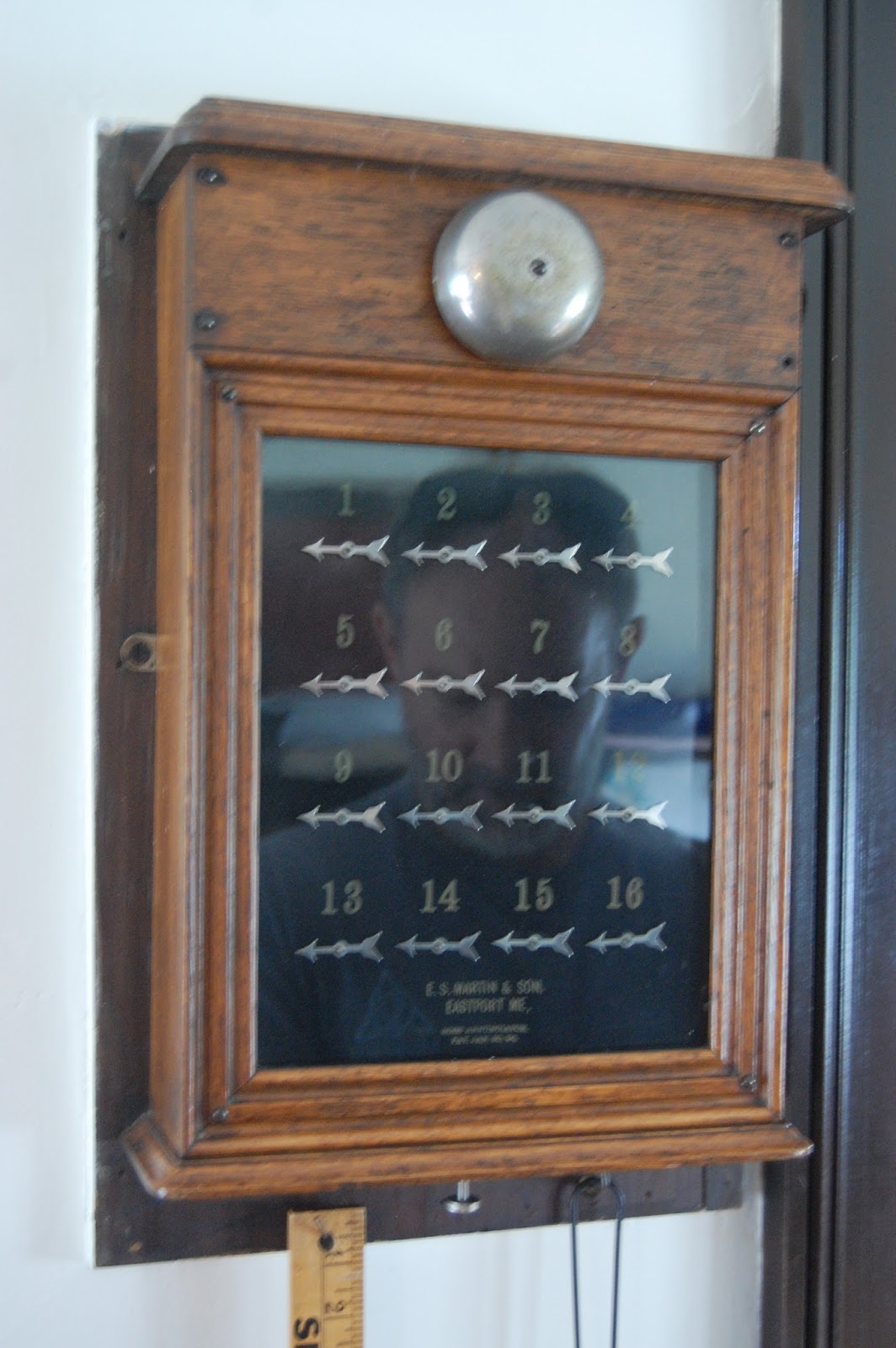
This was an interesting gadget, mounted on the kitchen wall...there were buttons in 16 of the rooms which, when pushed, would ring the bell on the top of this gadget, and the arrow of the corresponding room number would go up so the servants would know what room they were being called to.
Modern-day visitors enter through a side door that opens into the play room; this photograph is mounted on the wall directly opposite that entrance. It features the entire FDR clan, including his mother, who conveniently situated herself between her son and her daughter-in-law. Apparently Sara Roosevelt was quite a piece of work.
This is one of two living rooms; one is on the front of the house and this one is on the back, facing the ocean, which is to the right of where I was standing to take this picture. All of the furnishings in the house, with the exception of 5 pieces of furniture, are original.
The dining room also was on the back of the house to take advantage of the ocean views. A small table and two chairs were set up in front of the two back windows, where the two youngest boys ate when guests were present for a meal.
Though this was a summer cottage, Maine summer evenings can be chilly, and there are 7 fireplaces scattered throughout the cottage.
The two youngest boys shared a room in an addition to the cottage built in 1915.
A school room was included in the 1915 addition. A tutor was brought to the cottage each summer and the children had lessons in the morning before heading off to their various adventures in the afternoon.
The kitchen and butler's pantries were dreamy. What a luxury to have this kind of space and easy access to all your kitchen paraphernalia!
This was an interesting gadget, mounted on the kitchen wall...there were buttons in 16 of the rooms which, when pushed, would ring the bell on the top of this gadget, and the arrow of the corresponding room number would go up so the servants would know what room they were being called to.
September 1, 2013 - Part 3
We took our chances with this trip that we would find lodging each night, preferring to take whatever time we wanted in each destination and move on only when we were done. However, we had to scramble a bit last night to find a motel room, so when we passed this place on the way to the lighthouse we made a note to check it out on the way back. We had no idea what it was, but it said Lodging on the sign and our interest was piqued.
This is what we found when we drove up...it's the old West Quoddy US Coast Guard Station, which was decommissioned years ago and turned into an inn. We booked a night on the spot in the only room they had left. The building in the center is the station itself, which now features 5 bedrooms with shared living/dining areas, perfect for large groups or families. The garage on the left has been renovated into 4 studios, one of which we stayed in.
By the time we got back this evening, the sky had cleared enough to enjoy the sunset on the deck off our room.
This is what we found when we drove up...it's the old West Quoddy US Coast Guard Station, which was decommissioned years ago and turned into an inn. We booked a night on the spot in the only room they had left. The building in the center is the station itself, which now features 5 bedrooms with shared living/dining areas, perfect for large groups or families. The garage on the left has been renovated into 4 studios, one of which we stayed in.
I snapped a few pictures, including this shot of the "garage" doors, and then we headed out to our destination for the day.
By the time we got back this evening, the sky had cleared enough to enjoy the sunset on the deck off our room.
See that little sliver of yellow above the trees? That's the sun. :)
The reflection on the clouds after the sun dipped behind the trees was really something.
September 1, 2013 - Part 2
This morning we headed to the easternmost point of the United States - West Quoddy Head Light in Lubec, Maine. From the picture it is obvious why lighthouses are needed. :)
The light keeper's house has been turned into a museum and it was quite good. It was especially nice that we had the place, and the volunteer working there, to ourselves. The display pictured above explains that all lighthouses have unique light sequences so sailors will know which light they're at in they can't see the lighthouse itself, and gives amateur light keepers an opportunity to flash out the light sequence of West Quoddy Head Light.
The Bay of Fundy has the highest tides in the world - 52 feet!
"Easternmost Point in
the U.S.A.
West Quoddy Head
Lubec, Maine"
The fog was already starting to lift by the time we left the lighthouse.
September 1, 2013 - Part 1
We spent last night in Machias, on the way from Deer Island to Lubec on Rt 1. It was dark when we arrived, and we didn't know until we got up this morning that there was a saltwater inlet behind the hotel. What a nice surprise!
August 31, 2013
We embarked on a little road trip today to hit a few spots we've been wanting to see. The weather was not very cooperative, but I do love cloudy
days, even though they don't photograph very well, and they didn't
dampen our enthusiasm.
Our first destination was Deer Island, home of Dan Fogelberg (till he passed away shortly after we moved to Maine in 2007). Eggemoggin Reach is the body of water you cross from the mainland to Deer Island, part of a chain of islands connected by bridges, and Dan sang about this water in "The Reach." Jericho Bay lies east of the island chain; Dan sings about that water in "The Minstrel," one of my favorite songs.
Not long after we crossed the Reach to Deer Island, we spotted people standing out on the sand bar pictured above that stretched for probably a hundred yards into a saltwater inlet.
The problem was, the tide was coming in, so while I was taking pictures from the beach, Tracy and Jed were slowly losing their safe way back to shore.
One of the interesting things about this trip was the variation in lighting in the pictures I took...this picture and the one after were taken fairly close together in time, but the water looks so completely different to me.
We drove to the northeastern-most tip of the island chain to a town called Sunshine so we could get a good view of Jericho Bay, and there we met a very kind man who knew Dan lived on the Reach Road, which runs the length of Deer Island along Eggemoggin Reach. That happened to be our route off the islands so we followed it back to the mainland, although we saw no evidence of his home. It was enough to see the places Dan sang about. By this time the fog was rolling in and the bridge spanning Eggemoggin Reach was enveloped in it.
Our first destination was Deer Island, home of Dan Fogelberg (till he passed away shortly after we moved to Maine in 2007). Eggemoggin Reach is the body of water you cross from the mainland to Deer Island, part of a chain of islands connected by bridges, and Dan sang about this water in "The Reach." Jericho Bay lies east of the island chain; Dan sings about that water in "The Minstrel," one of my favorite songs.
Not long after we crossed the Reach to Deer Island, we spotted people standing out on the sand bar pictured above that stretched for probably a hundred yards into a saltwater inlet.
The problem was, the tide was coming in, so while I was taking pictures from the beach, Tracy and Jed were slowly losing their safe way back to shore.
Jed was really excited to find this intact crab shell enmeshed in seaweed. We brought the whole thing home with us, though I have no idea at this point what exactly we're going to do with it.
Jed even found this little live crab, which took quite a bit of convincing to warm up to us.
One of the interesting things about this trip was the variation in lighting in the pictures I took...this picture and the one after were taken fairly close together in time, but the water looks so completely different to me.
Regardless, they are two of my favorite shots from the trip.
Quirky art abounded on the island.
We drove to the northeastern-most tip of the island chain to a town called Sunshine so we could get a good view of Jericho Bay, and there we met a very kind man who knew Dan lived on the Reach Road, which runs the length of Deer Island along Eggemoggin Reach. That happened to be our route off the islands so we followed it back to the mainland, although we saw no evidence of his home. It was enough to see the places Dan sang about. By this time the fog was rolling in and the bridge spanning Eggemoggin Reach was enveloped in it.
Subscribe to:
Posts (Atom)